
How it works
How an agent finds stores for your brand, step by step
The fastest way to understand StockistScout is to follow one business from the first question to the first reply. Here is a made-up example, with every step the app really takes.

Meet Clay & Fern, a small ceramics studio. They make mugs, bowls and vases by hand, they sell some online, and they want more gift and home shops to carry their work. They have tried sending emails themselves: it takes hours to find the right shops, and most messages never get an answer.
This is what happens when they give the job to an agent.
1. They describe the business, the customer and the offer
The setup is a questionnaire in three parts. It is detailed on purpose, because everything the agent does later comes from it.
- Your business: what they sell (handmade stoneware mugs, bowls and vases), their website, their best sellers and their wholesale price range.
- Your ideal customer: independent gift, home and décor shops that carry handmade or local products, with a website, in the United States; no big chains and no discount stores. They add three shops they would love to be in, as examples.
- Your offer: a $250 opening order, payment on invoice after the first order, no samples but a small trial assortment, free shipping on the first order, and the next step they want: “reply and we send the wholesale catalogue”.
At the end of each part, Katya, the setup coach, reads what they wrote and suggests improvements field by field. She never invents a price or a discount: if a fact is missing, she asks for it.
2. The right specialist takes the job
Each kind of store has its own agent. Gift and home shops belong to Elias, so Elias takes Clay & Fern’s ideal customer: his own search, his own emails and his own report on the dashboard. A brand that sells to two kinds of stores, say gift shops and garden centres, uses two ideal customers and gets two agents.
3. The agent finds stores, and says why each one fits
Elias searches the web for shops that match the description and checks each one: what it sells, where it is, whether it has a business email it publishes, and whether it is a chain or one of the shops Clay & Fern excluded. Most candidates are discarded on purpose. Every store he keeps comes with one line that says why it fits.
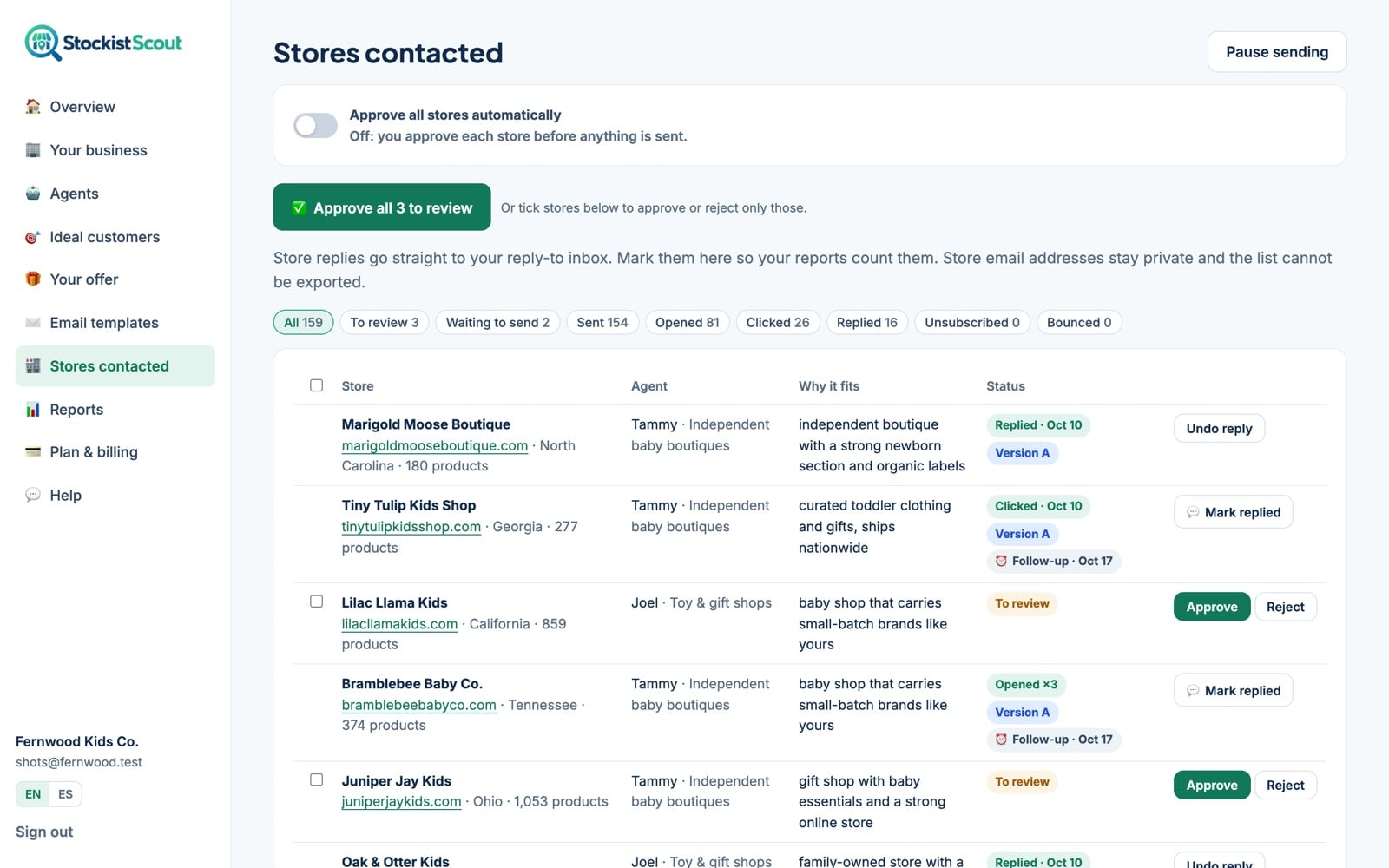
Stores are approved automatically. If Clay & Fern prefer to approve each store themselves, they switch that on, and the shops they reject are never proposed again.
4. One reviewed template, a different email for each store
Before anything goes out, the email template is reviewed. An AI checks that it is honest, that it promises nothing the facts do not support, that it carries a real sender, a postal address and an opt-out, and that it does not read like spam. A template that needs changes comes back with notes, and “Fix it with Katya” proposes how to solve each one.
From that approved template, Elias writes each shop its own email, and mentions what makes that shop a good place for handmade ceramics. It goes out under Clay & Fern’s name, with their email as the reply-to.
5. Sending, a little more each week
A new sender that sends a lot at once ends up in spam. So every account starts at 25 emails a day and rises 50% each week after a healthy week, up to 500 a day per sending domain. Clay & Fern chose Plus, 1,000 emails a month, which the ramp reaches in its second week.
6. The replies land in their own inbox
When a shop answers, it writes to Clay & Fern directly, in the email app they already use. The conversation, the catalogue and the first order are theirs, with no commission. On the dashboard they see, for every agent and every day, how many emails went out, how many were opened, clicked and answered.
What we promise, and what we do not. We promise stores that match what you described, careful reviewed emails and limits that protect your name. We do not promise orders: whether a shop buys depends on your product, your price, your offer and your conversation with them.
What to prepare before you start
- Your wholesale prices and a minimum order you are happy with.
- Three to five stores you would love to be in: they teach the agent your taste.
- An email address you read every day, for the replies.
The trial gives you 50 emails, no card needed, so you can see the stores, the emails and the replies before you pay anything. See how it works or compare the plans.
Keep reading

Selling to stores in another country: a factory in China finding US shops
Your business can be anywhere and your agent writes to stores in another country, in their language. A worked example: a ceramics factory in China looking for its first US stockists, with the numbers of each month.

What to put in your wholesale offer: minimum order, terms, samples and a first-order offer
The five answers a store buyer looks for in a first email from a new brand, with examples of each, and the mistakes that cost replies.

Describe the stores you want: an ideal customer your agent can use
The better you describe the stores you want, the better the stores your agent finds. What to write in each field, with a weak and a strong example.